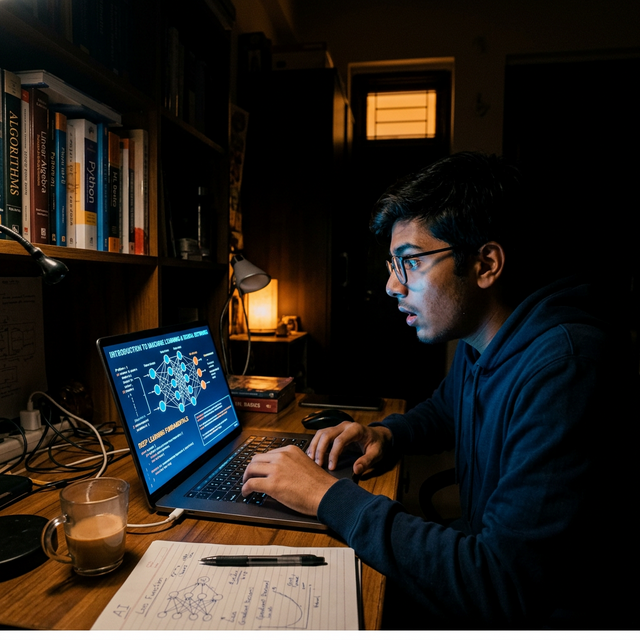
The Night I Discovered Machine Learning
It started with a coincidence that felt too precise to be random. I was watching a video on YouTube late one night, and I was thinking about another video I wanted to watch next. Before I could even search for it the moment the current video ended YouTube surfaced that exact video as the top recommendation. I stopped. I stared at the screen. How did it know?
The Moment That Changed Everything
I had been mindlessly watching videos for an hour or two, jumping from one topic to the next the way you do when you're not really looking for anything in particular. At some point, I saw a thumbnail in the sidebar and thought: "That looks interesting, I'll watch that after this one." I made a mental note and kept watching.
The video ended. And there it was right at the top of the recommendations. That exact video. The one I had just been thinking about.
My first instinct was coincidence. But it bothered me. How could a platform predict something I hadn't even typed, hadn't clicked, hadn't done anything to signal? I had just thought about it. Something about the way I had been watching the sequence of topics, the watch time, the patterns had apparently been enough.
The Question I Couldn't Stop Asking
I closed the laptop. But the question stayed open: how does YouTube know what I want to watch next?
I started searching. That led to articles about collaborative filtering, about recommendation systems, about algorithms that learn from behavior patterns across millions of users. I had no idea any of this existed. I had never heard the term "machine learning" used in any way that felt real just abstract buzzword stuff in tech news. Now here it was, quietly running the video I was just thinking about to the top of a screen.
Machines could learn what humans wanted not because a programmer told them "if user watches X, show Y," but because they had discovered patterns in data that no human had explicitly encoded. They had generalised from examples. They had, in some meaningful sense, understood something about human interest.
The Rabbit Hole at 2 AM
I kept reading. YouTube at first, then recommendation systems broadly, then machine learning as a field, then the mathematics behind it. I watched 3Blue1Brown's neural network series. I read Wikipedia articles on gradient descent at 4 AM, barely understanding any of it but unable to stop. I fell asleep with tabs open and woke up continuing where I left off.
I didn't understand most of it yet. But I couldn't stop. It was the same feeling as my first working program something clicked, something that felt urgent and real and bigger than anything I had been studying in class.
"The best obsessions feel less like choices and more like gravity. You don't decide to fall in you just realise you already have."
From Watching to Doing
After a couple of weeks of watching and reading, I finally opened a code editor. I found a scikit-learn tutorial and trained my first classifier a decision tree on the Iris dataset. The classic beginner move. But the moment I saw the accuracy score print out 95% it landed differently than any other program I had written. I had made a machine learn from data.
It was terrible code. The model was trivial. The dataset was decades old. None of that mattered. I had crossed from watching to doing.
How That Night Changed My Career
That one coincidence YouTube recommending the exact video I was thinking about is the direct ancestor of everything that came after: building JARVIS as my first real AI project, winning a college hackathon with an AI resume parser, getting a paper published at IEEE AIC (Applied Intelligence and Computing) on Bayesian deep learning, building RAG pipelines on AWS, and achieving ~99% LLM token reduction in a live agentic AI pipeline at Idyllic Services.
None of it was planned. It all flowed from one late night, one coincidence, and one question I couldn't let go of.
What This Taught Me About Learning
That night taught me that genuine curiosity the kind that shows up uninvited and won't leave is the most reliable signal for what to learn next. Mandatory coursework had never produced that kind of pull. A YouTube algorithm did.
Since then, I've always paid attention to the questions that bother me in a good way not what seems impressive or career-relevant, but what I'd still be reading about at 2 AM when nobody's watching. That's been my compass.
If you're early in your journey and haven't found your "how does that work?" moment yet keep looking. It exists. And when it finds you, everything changes.
Curious about AI/ML and want to talk through your learning path? I'm always happy to connect with developers at any stage.
Get In Touch