How I Became the DSA Team Lead at College — and Mentored 300+ Students
I didn't apply for the DSA Lead role with a polished resume and a prepared speech. I got it because I simply refused to let the community stagnate — and kept showing up, every single week.
The Community That Almost Died
Hackslash was our college's competitive programming and tech club. When I joined in second year, it was… quiet. Events happened occasionally. Workshops were poorly attended. There was no real curriculum, no structure, and no urgency. The seniors who ran it were busy with placements and couldn't commit time.
I started showing up to every session anyway — not as a leader, just as a regular member who was genuinely trying to get better at DSA. I practiced problems, asked questions, and helped juniors when they were stuck — even when nobody asked me to.
How It Actually Happened
By third year, one of the senior leads asked me directly: "You're already doing the work — do you want the title?" There was no grand selection process. Leadership wasn't assigned to the smartest coder in the room. It went to the person who was consistently present and consistently useful.
"Leadership in a community isn't about being the best — it's about caring the most, consistently, when nobody's watching."
What Running Workshops Actually Taught Me
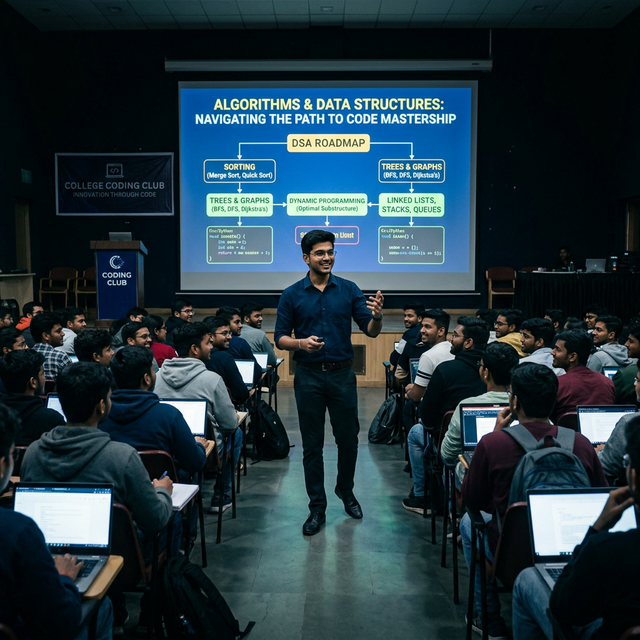
In my year as DSA Lead (June 2024 – June 2025), I ran 5+ workshops, organized coding competitions, and mentored 300+ students directly. The workshops themselves were the hardest part — not because the content was hard, but because explaining a concept clearly is 10x harder than just knowing it yourself.
I had to figure out:
- How to explain recursion to someone who's never seen it — without using jargon
- How to structure a session so beginners aren't lost but intermediates aren't bored
- How to make "dynamic programming" feel approachable instead of terrifying
Teaching forced me to understand DSA deeply in a way that solo practice never could. Every session made me a better developer.
What I'd Do Differently
I'd start the structured curriculum earlier. We ran workshops reactively — someone needed help with trees, we did trees. Someone struggled with graphs, we covered graphs. I wish I had built a proper 12-week roadmap from day one: arrays → recursion → sorting → trees → graphs → DP. Linear, progressive, measurable.
I also wish I had created a mentor network — pairing seniors with juniors — rather than trying to be the single point of contact for everyone. Scalable leadership is about building systems, not being a hero.
Interested in competitive programming, AI/ML, or web development? I'm always open to connecting with students and builders.
Get In Touch